This is the question we get asked the most since we launched our AI agent offering: "But… what's actually the difference with ChatGPT? We already have a subscription."
Right behind it comes the same question from another angle: "and is an AI agent different from a chatbot?"
Short answer, which we'll unpack together:
ChatGPT is a conversation interface. An AI agent is an autonomous program that uses a language model as its engine.
That distinction matters, because it decides whether you have a personal productivity tool or a digital coworker that gets things done without supervision.
ChatGPT is a conversation. You're the pilot.
When you open ChatGPT (or Claude, or Gemini, it's the same mechanic), here's what happens: you type something, the model replies, then it waits. If it needs more information, you provide it. If the answer needs reshaping, you ask. If you want the same treatment tomorrow on new data, you open a fresh conversation and start over.
It's a great tool. You're probably already using it to draft emails, summarize documents, brainstorm ideas, debug an Excel sheet. But notice the essential trait: you're in the loop at every step. ChatGPT doesn't act on its own. It waits for your instructions, replies once, and stops.
It's a copilot, not a pilot. That's not a flaw. It's what the product is designed to do.
An AI agent is a program that works in a loop toward a goal
Simon Willison, one of the most respected voices in the English-speaking developer community on this topic, spent two years collecting definitions of the word "agent" from his community before proposing one that eventually reached consensus. Here it is:
An LLM agent runs tools in a loop to achieve a goal.
Terse, but exact. Let's unpack it.
"A program": not an interface you open, but software that runs in the background, on a server, without you having to invoke it. It starts when an event arrives (a new email, a new form submission, a specific time each morning) or when you ask it to, and it keeps running until the work is done.
"Uses an LLM as engine": at the heart of the agent, there's a language model (GPT, Claude, Gemini, it doesn't matter which one). That's the part that "reasons". But the model is only one component, not the whole thing.
"With tools": the agent has access to your systems. Read emails. Write to a database. Call your CRM. Consult a pricing sheet. Send a Slack message. Each tool is a concrete action it can take.
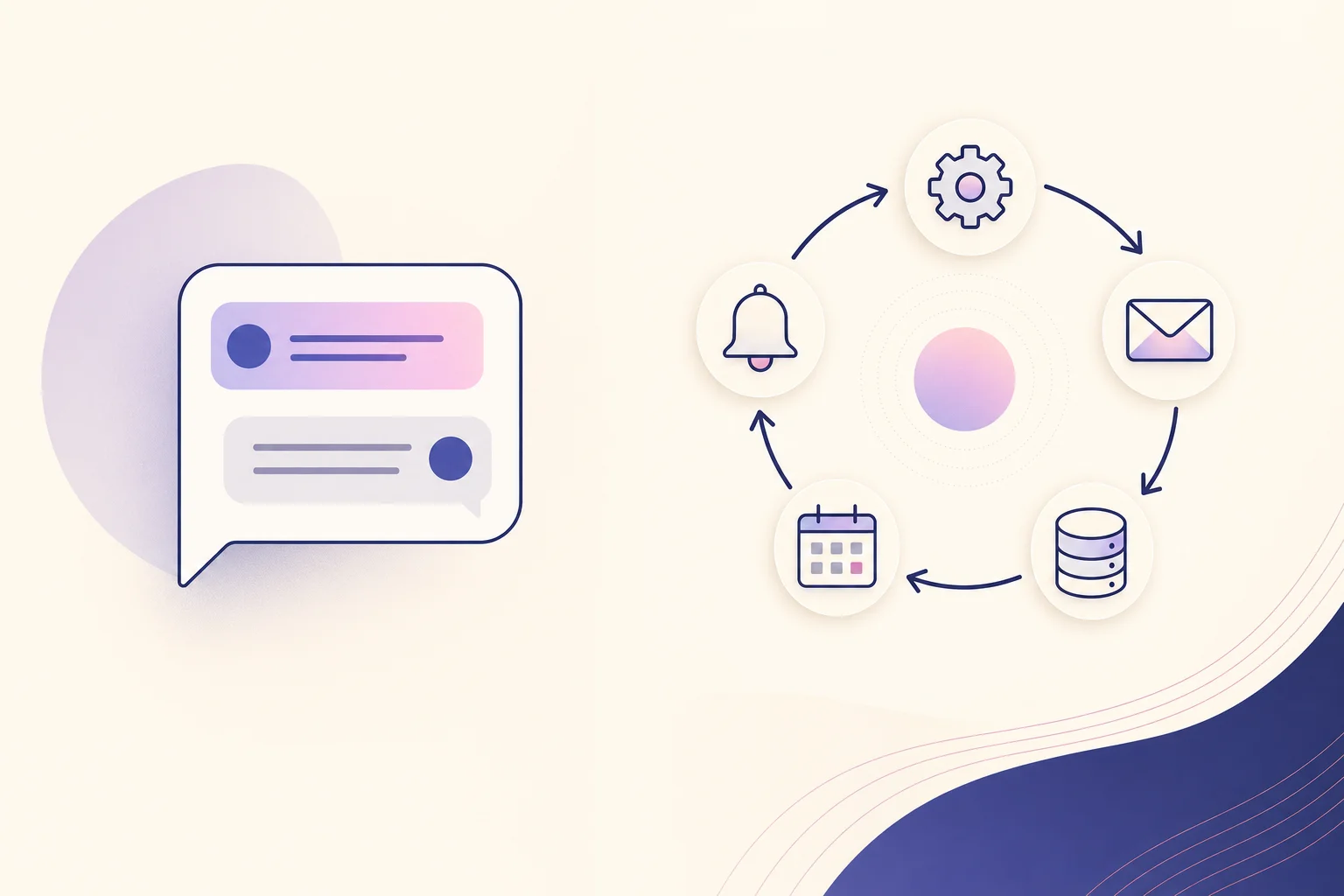
"In a loop": this is the part that changes everything. The agent asks the model: "what should I do next?" The model says "use this tool". The agent executes, looks at the result, asks the model again: "and now?" And so on, until the goal is reached.
"Toward a goal": not an open-ended conversation, but a specific task to accomplish. Extract the data from this invoice and push it to accounting. Sort incoming emails and route urgent ones. Answer quote requests within 2 minutes.
Four concrete differences
If you prefer concrete lists to quotes, here's the same idea sliced differently.
1. Who starts what
ChatGPT: you start every interaction by typing a prompt. No prompt, no action.
Agent: an event triggers the agent (new email, upcoming appointment, new lead in the CRM). The agent starts on its own.
2. Access to tools
ChatGPT: knows the world thanks to its training, but can't touch your systems. You have to copy-paste context manually.
Agent: wired directly into your email, your CRM, your accounting, your Drive. Reads what it needs, writes where it needs to.
3. Persistence
ChatGPT: one conversation at a time. Each session starts over (except for the limited "memory" features you allow it).
Agent: runs continuously, keeps state on tasks in progress, picks up where it left off after a crash.
4. Scope
ChatGPT: generalist. Answers anything about anything.
Agent: specialist. Designed and tuned for one specific task, which it does better and faster than a generalist solution.
AI agent vs chatbot: what actually separates them
Same family of confusion, one notch further along: if a chatbot already answers your customers on your website, don't you already have an agent?
No. And the difference comes down to a single verb: act.
A chatbot answers. Whether it's scripted (a decision tree, buttons, canned replies) or driven by a language model (it rephrases, it handles awkward questions, it adapts its tone), the output is still text shown to a human. It says when the store closes, it digs up the return policy, it reassures a customer at 11 p.m. on a Sunday. Then it hands control back. If something actually has to happen inside your systems, someone on your team does it afterward.
An agent acts. It has tools, and a tool isn't a sentence: it's a record created in the CRM, a write to your database, an email sent, an invoice pushed into accounting. It chains those actions in a loop until the task is done, and it can start without anyone typing a thing.
The simplest test, when a vendor sells you "an agent": ask what has changed inside your systems once it has finished working. If the answer is "nothing, it answered the customer", you're buying a chatbot. That's not an insult, it may be exactly what you need. But it isn't the same price or the same level of risk, and you want to know that before signing.
A good chatbot wired into your documentation is often the right first step anyway: it costs less and it ships in weeks. More to the point, it shows you, with real numbers, which requests come back often enough to justify an agent behind them.
The honest caveat: the line is blurry
Two clarifications, because marketing oversimplifies and we'd rather be honest.
First, ChatGPT itself can now use tools: web browsing, code execution, "custom GPTs" with actions. When ChatGPT runs tools in a loop to answer your request, it technically behaves like an agent in Simon Willison's sense. The line isn't a wall, it's a gradient.
Second, a well-built agent is more specific than a ChatGPT with tools, and that's the real practical difference. A custom GPT you share with your team is useful. An agent dedicated to your workflow, connected to your data, with specific business rules and a defined supervision model, is a different class of reliability and autonomy.
Anthropic, the company building Claude, formalizes this distinction between "workflows" (systems where the AI follows a predefined path) and "agents" (systems where the AI dynamically directs its own actions based on context). A custom GPT tends toward workflow. A real enterprise agent tends toward agent.
ChatGPT's "agent mode", and what became of it
A lot of people land here after hearing about ChatGPT's agent mode, the one that promised ChatGPT would finally think and act. Here's where things stand as of August 17, 2026, read on OpenAI's own pages rather than the summaries floating around.
The product called "ChatGPT agent", the one you switched on from the tools menu, has been replaced. On its own help page, OpenAI states it is no longer available and points to ChatGPT Work, described as an agent designed for longer, multi-step work and finished deliverables. So ChatGPT is now split in two: Chat for quick questions and conversation, Work for tasks that need follow-through. Work is limited to paid plans. It can run once, repeat on a schedule or a trigger, monitor for changes, and it asks you to approve the important actions.
There's also a cloud browser, which lets ChatGPT go out on the web for you: navigate pages, fill in supported fields, and combine what it finds with your connected apps.
And that's exactly where the ceiling shows up for a business. OpenAI spells it out: at launch, that browser only works on public pages. It does not accept credentials, it does not use autofill or password managers, it does not sign in to websites, and it does not complete payments. If a step requires any of those, the task stops.
Translate that into your week. Work can absolutely comb through three competitors and hand you a clean deck the next morning. It will not open your operations software to create the order, because that would mean signing in. It's a generalist assistant, a very strong one, working from inside ChatGPT. An enterprise agent is wired into your systems with your own access, your business rules and your guardrails, and its work is measured by what moved in your data once it finished.
The two aren't competing. Work makes your team faster on one-off tasks. An agent takes the weekly ones off their plate entirely.
The practical analogy for your business
Here's how we frame it for clients who ask.
ChatGPT is a brilliant intern, available 24/7. You can ask it anything, it answers fast, it understands the context you give it. But it only does what you ask, when you ask. It won't read your emails for you, it won't connect to your accounting, it won't follow up with a client tomorrow morning unless you clicked "send".
An AI agent is an employee dedicated to a specific task. You hire it to sort your emails, process your invoices, answer quote requests. It has access to the systems it needs, it runs continuously, it does its job while you do yours. It doesn't take coffee breaks and it doesn't forget a Friday-evening emergency.
Both have a place in a business. ChatGPT for one-off tasks, exploration, drafting. An agent for the repetitive tasks that eat hours every week and that no human enjoys doing.
Why the distinction matters for your business
Because the two solutions don't solve the same problem.
If your problem is that your team needs an accelerator to write, summarize, or think faster: a ChatGPT or Claude subscription handles 80% of that need. Deploy it, train your team, measure the gains. Start there.
If your problem is that you have tasks that come back every week, that eat hours from your team, and that stop you from taking on more clients because nobody has the time: ChatGPT won't handle them for you. You need an agent. Designed for that specific process, connected to your systems, supervised by your team.
Confusing the two is expensive. Companies spend six months trying to fit a hammer into a screw hole because someone sold them on "AI does everything". AI does nothing on its own. Well-built architectures do a lot, when you build them for the right problem.
Where to start
If you're already using ChatGPT and wondering whether an agent would add something: the answer depends entirely on the task. We can talk about it in 30 minutes, no strings attached. We look at where you are, identify tasks where an agent would make sense, and tell you straight if now is the right time or not.
 Written byXavier Peich